MASTEEL’S APPROACH
TO SUSTAINABILITY
Message From Executive Vice Chairman

DATO’ SRI TAI HEAN LENG
@ TEK HEAN LENG
Executive Vice Chairman
Masteel remains firmly committed to strengthening our corporate governance, sustainability, and transparency across all stakeholder groups. In an increasingly complex and sustainability-driven business environment, we recognise that long-term value creation is closely linked to our ability to effectively manage sustainability-related risks and opportunities. We continue to embed ESG considerations into our core business strategy, decision making processes, and operational practices and aligns our sustainability approach with internationally recognised frameworks, including the Global Reporting Initiative (“GRI”), the United Nations Sustainable Development Goals (“UN SDGs”), and the International Sustainability Standards Board (“ISSB”) standards, namely IFRS S1 & S2, as well as the Bursa Malaysia Sustainability Reporting Guide (3rd Edition).
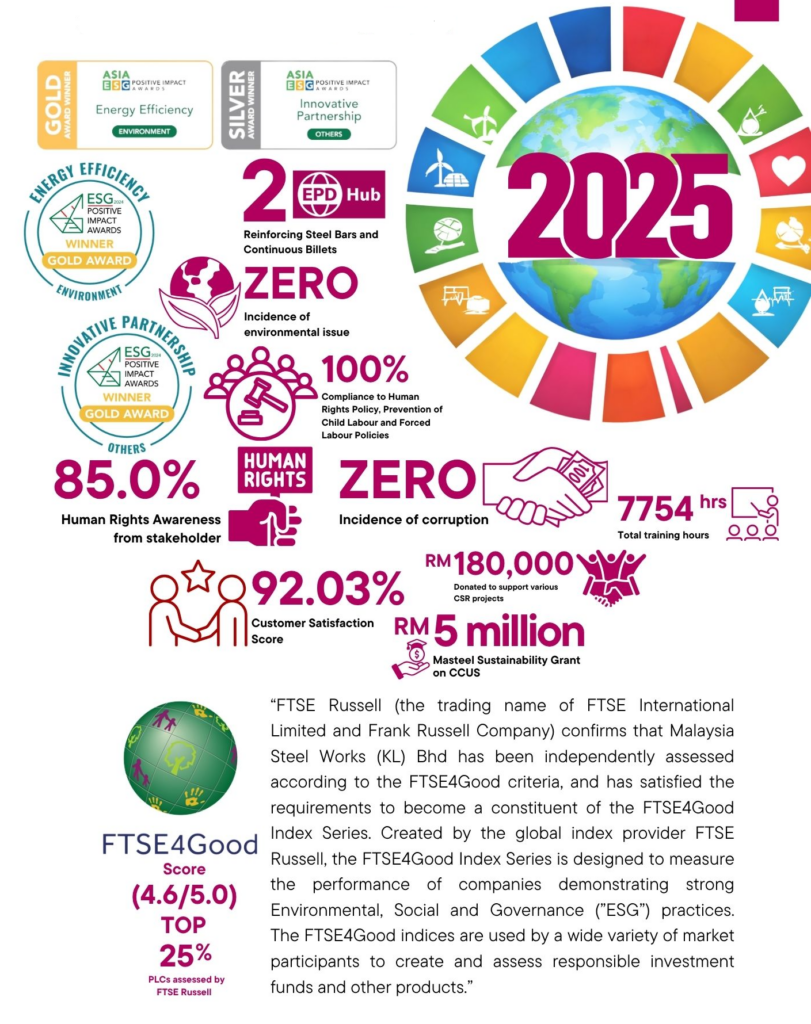
These frameworks provide a structured basis for identifying material sustainability related risks and opportunities, ensuring transparent, consistent, and decision-useful disclosures while strengthening resilience and long-term strategic positioning. Masteel achieved significant milestones in FY2025 with multiple prestigious recognitions, including the Prime Minister’s Hibiscus Award (“PMHA”) 2024/2025 – Notable Achievement in Environmental Performance, the Asia ESG Positive Impact
Awards 2025 (Gold Award in Energy Efficiency and Silver Award in Innovative Partnership for Large Companies), and The Star ESG Positive Impact Awards (Gold Winner in Energy Efficiency and Innovative Partnership for Large Companies). In addition, Masteel was recognised as a 3-Star Lister by the UN Global Compact Network Malaysia & Brunei (“UNGCMYB”). We also maintained our 4-star FTSE Bursa Malaysia EMAS ESG Rating, placing us among the top 25% of listed companies. These recognitions reflect the effectiveness of our ESG strategy and reinforce stakeholder
confidence in our sustainability performance.
In 2025, we reassessed our materiality matrix to ensure that our sustainability priorities remain aligned with evolving stakeholder expectations, regulatory developments, and business risks. We further strengthened our reporting by adopting IFRS S1 and IFRS S2 in alignment with Malaysia’s National Sustainability Reporting Framework (“NSRF”). This enhances our capability to systematically identify, assess, and manage climate-related risks and opportunities, including both transition and physical risks, and to integrate these considerations into our financial and strategic planning processes.
The significant progress between FY2024 and FY2025 reflects Masteel’s continued advancement in sustainability integration and operational performance. One of our most notable achievements in FY2025 is the completion of comprehensive Life Cycle Assessments (“LCA”) and the successful development of Environmental Product Declarations (“EPDs”) for our products. Masteel obtained two third-party verified EPDs for Reinforcing Steel Bars and Continuous Billets under the EPD Hub programme. These disclosures, developed in accordance with EN 15804+A2 and ISO 14025 standards, provide transparent and comparable information on product-level environmental impacts, including carbon footprint, energy consumption, and resource utilisation, supporting sustainable procurement and market positioning.
In parallel, Masteel continued to advance our decarbonisation initiatives through the installation of solar panels at our Petaling Jaya plant and the implementation of Direct Casting and Direct Rolling technology, which eliminates fossil fuel usage in billet reheating. These process improvements enhance energy efficiency and reduce operational emissions. As a result, Masteel achieved improved carbon intensity performance (Scope 1 & 2), recording 0.456 tCO₂e/mt for the steelmaking plant and 0.085 tCO₂e/mt for the rolling mill plant in FY2025.
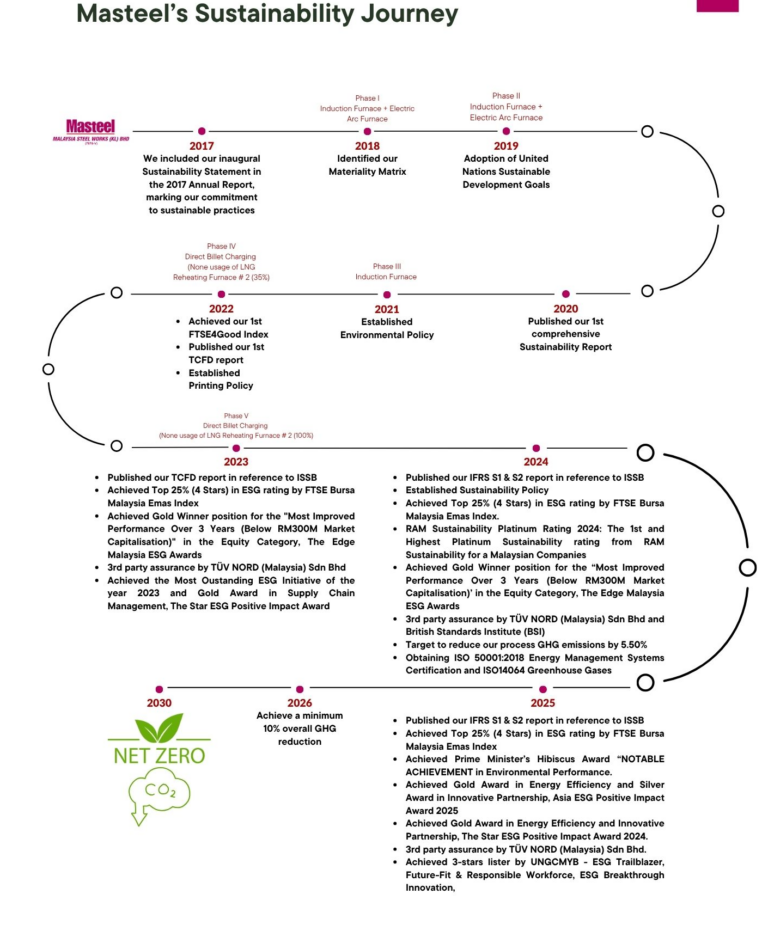
Masteel is also progressing towards our long-term ambition of surpassing Malaysia’s commitment of achieving net-zero emissions by 2050, supported by a RM5 million investment in a Carbon Capture, Utilisation and Storage (“CCUS”) project in collaboration with ACE Gases Sdn Bhd and Universiti Tunku Abdul Rahman (“UTAR”) through the evolution of the Masteel Sustainability Grant. Beyond research, the programme facilitates knowledge transfer, supports industry-relevant innovation, and enhances talent development by providing students and researchers with exposure to real-world industrial sustainability challenges. These initiatives form part of our structured decarbonisation pathway, targeting a 10% reduction in GHG emissions by 2026 and achieving net zero by 2030, consistent with our climate transition strategy.
As part of our broader sustainability strategy, Masteel recognises the importance of contributing to public discourse and policy development on climate change. In 2025, we continued our support for the Institute for Democracy and Economic Affairs(“IDEAS”) in the development of the research paper titled “Carbon Pricing for the Malaysian Steel Industry: Incentivising Sustainable Growth.” This initiative contributes to national policy dialogue and supports the transition towards a low-carbon economy. Masteel remains committed to upholding internationally recognised human rights principles across our operations and value chain. As part of our human rights due diligence process, we conduct annual stakeholder assessments to evaluate awareness and understanding of our Human Rights Policy. In FY2025, 85% of stakeholders acknowledged and understood the principles outlined in the policy, reflecting strong awareness and engagement. We maintain zero tolerance for human rights violations and ensure compliance with ethical business practices across all operations, including third-party engagements. Our approach is guided by our Code of Conduct and supported by governance structures that ensure accountability, transparency, and continuous improvement.
By embedding sustainability considerations across all levels of the organisation, Masteel strengthens stakeholder trust, enhances innovation, and improves resilience against evolving regulatory and market expectations. Our commitment to ESG extends beyond compliance; it is integral to our corporate strategy and value creation model. Masteel will continue to balance economic performance with environmental stewardship and social responsibility, ensuring sustainable growth and long-term value for our stakeholders, employees, and the communities we serve. We thank all stakeholders for their continued trust and support as we work together towards a more sustainable and resilient future.
Thank you.
Dato’ Sri Tai Hean Leng @ Tek Hean Leng
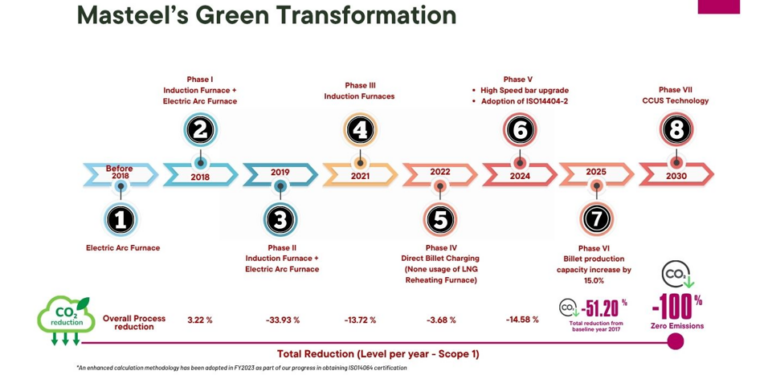
Masteel has implemented a structured seven-phase decarbonisation roadmap spanning from before 2018 to 2027 to systematically reduce Scope 1 carbon emissions across our steel manufacturing operations. The most significant reduction of 33.93% was achieved during Phase I and Phase II (2018–2019) through the transition from a conventional Electric Arc Furnace to a hybrid Induction Furnace and Ladle Refining Furnace configuration, followed by a full shift to Induction Furnaces in Phase III (2021), delivering an additional 13.72% reduction. In Phase IV (2022), the adoption of Direct Billet Charging, which eliminated the use of LNG-fired reheating furnaces, contributed a further 3.68% reduction. Looking ahead, Phase V (2024) focuses on a High-Speed Bar Upgrade and the adoption of ISO 14404-2 to enhance operational efficiency and emissions measurement accuracy, targeting a further reduction, while Phase VI (2025) involves a 15.0% increase in billet production capacity to optimise resource utilisation without compromising sustainability performance. Collectively, these initiatives have delivered a 51.20% reduction in Scope 1 emissions from the 2017 baseline, with Phase VII (2030) centred on the integration of Carbon Capture, Utilisation and Storage (“CCUS”) technology, positioning Masteel to support Malaysia’s net-zero emissions by 2030 ambition and reinforcing our leadership in sustainable steel manufacturing.
Sustainability Highlights 2025